
Critical Perspectives Webinar Series - KORA: Building an Open-Source Benchmark for AI Child Safety — Methodology, Findings, and the Road Ahead
We are running a massive, uncontrolled experiment on our children. AI is now in the hands of millions of kids and teens, and we still do not really know whether it helps them thrive or puts them at risk. KORA starts from a simple idea: you cannot improve what you do not measure. We built the first independent, open-source benchmark to evaluate how safe frontier AI systems are for children, working with more than 30 child-safety experts to define 25 critical risks and test 35 models on hundreds of thousands of realistic synthetic conversations.
This talk walks through KORA's taxonomy, scoring method, and main findings: educational integrity as the industry's weakest spot, child-aware prompting as a powerful lever (+25 points across all models), and human redirection as the strongest predictor of overall safety. We also share what KORA does not yet capture, the limits of synthetic evaluation, and where we need pushback, replication, and collaboration to move the field forward.
Mon, 8 Jun 2026 16:00 - 16:45 (UTC+00:00) Dublin, Edinburgh, Lisbon, London
Register now
Critical Perspectives Webinar Series - When AI Feels Social: Developmental Mechanisms, Vulnerability, and the Risks of Emotional Dependency
This talk examines why conversational AI can feel socially meaningful to children and adolescents, drawing on two studies of relational AI appeals among socially and emotionally vulnerable adolescents and young children’s anthropomorphism of an AI chatbot. I will discuss psychological mechanisms that may make AI feel like a social companion, with attention to developmental vulnerability and the emerging risks of emotional dependency on AI.
Dr. Pilyoung Kim is Professor in the Department of Psychology at the University of Denver and the Director of the Center for Brain, Artificial Intelligence, and Child (BAIC). She is widely recognized for her expertise in brain development and human emotional bonding, particularly in parent-child relationships. At the BAIC Center, she bridges developmental science and AI design to protect and support children. Professor Kim’s current research focuses on the emotional and social dimensions of child-AI interactions, with a strong emphasis on AI safety. Dr. Kim received her PhD in Developmental Psychology from Cornell University, and completed a post-doctoral fellowship at the National Institute of Mental Health (NIMH). Professor Kim has authored over 100 publications, with her research supported by prestigious funding agencies, including the U.S. National Science Foundation (NSF) and the National Institutes of Health (NIH).
Critical Perspectives Webinar Series - The Role of AI Moderation in Building Safer Social Platforms
A key challenge in building safe, age-appropriate social platforms is moderating content accurately at scale. As the volume of user-generated content grows, relying solely on human review becomes both impractical and ethically complex, particularly given the exposure to harmful and traumatic material.
This session explores how AI moderation systems can support this challenge, not only by improving scale and efficiency, but also by helping define and respond to different thresholds of harm. Natalie Boll, Founder and CEO of Tribela, will share how Tribela has developed AI tools to work alongside human judgment, reducing exposure to harmful content while maintaining nuance and context. The discussion will also touch on the balance between safety and freedom, and how AI can be designed to protect users without limiting expression.
Natalie Boll is the Founder & CEO of Tribela, a new social media platform which prioritises safety over algorithmic engagement, creating a safe space for young people to interact and engage. Prior to this, Natalie produced for CBC, Netflix, Amazon, HGTV, and the Food Network. She has directed a feature documentary now airing on CBC, line-produced franchise films, run a globally recognised restaurant in Vancouver Gastown, and was named to the city's 40 Under 40. She is also the mother of three. That is the part that matters most. Tribela exists because she could not, in good conscience, hand her kids the internet she helped build. After two decades watching media optimise for attention at any cost, Natalie went back to school — Oxford's Advanced Management & Leadership Programme, the Women's Leadership Programme, Harvard Business School Online, Yale's Science of Well-Being for Teens, the Centre for Humane Technology's Foundations of Humane Technology, even CS50 — to build the alternative herself. Tribela is now live in 40+ countries with paying members, incubated at Oxford University Innovation, and validating a model that is not built on advertising. Her work sits at the intersection of design, culture, and real-world experience.
Mon, 11 May 2026 16:00 - 16:45 (UTC+00:00) Dublin, Edinburgh, Lisbon, London
Join: https://teams.microsoft.com/meet/340009717710056?p=qBMvYLEmX6JJQ4ao0U
Meeting ID: 340 009 717 710 056
Passcode: Se7xa9Mn
Shaping AI for the Next Generation
We invite you to a thought-provoking event that will examine the transformative impact of Artificial Intelligence on children’s future. Our panel of experts will explore how AI can be harnessed to unlock unparalleled benefits for the next generation, while proactively addressing and mitigating potential downsides—especially in the realms of education and human relationships.
Generation AI Symposium
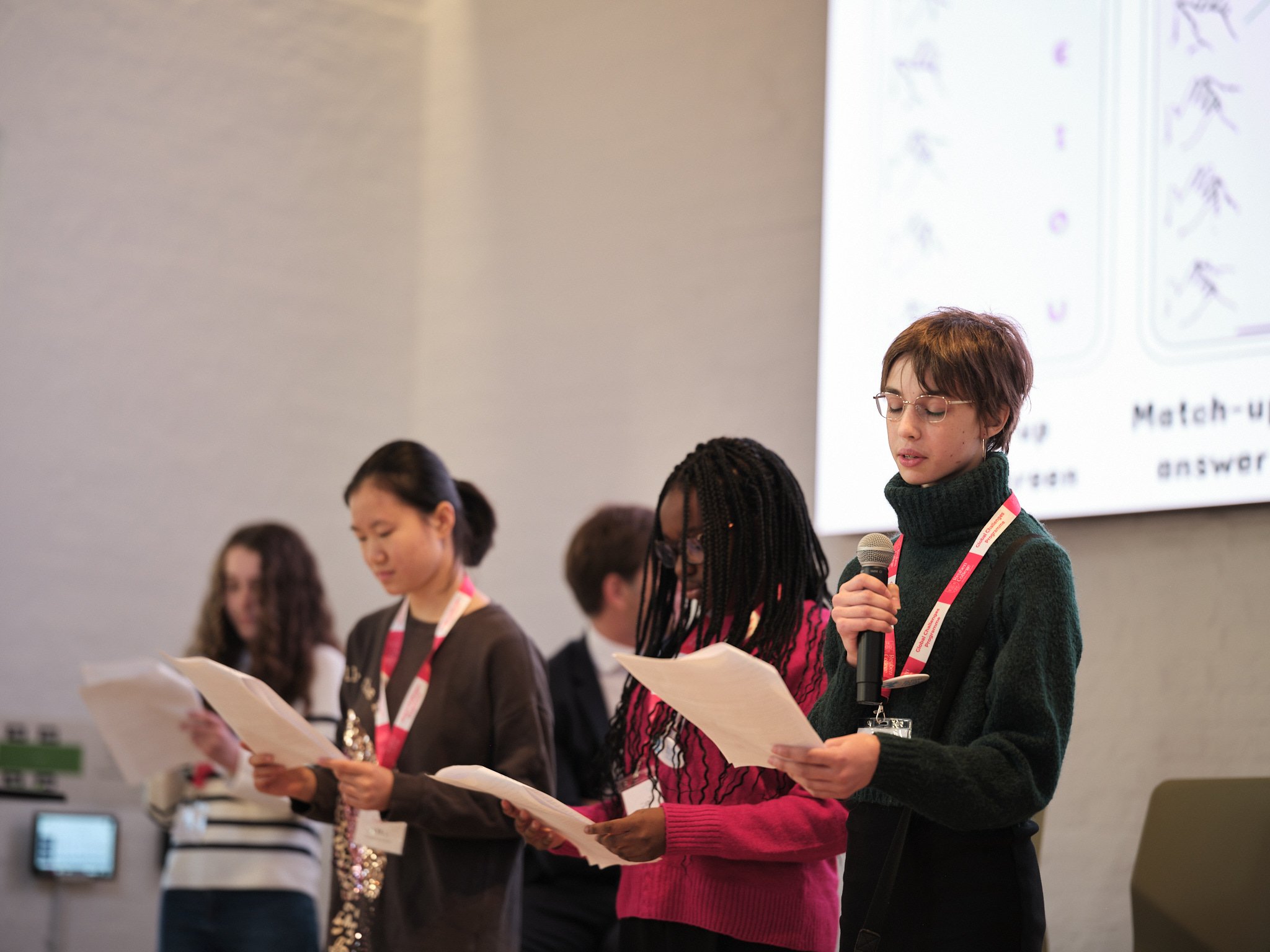
Our Generation AI: The Future of Technology & Young People Symposium on Saturday 14 September 2024 brought together researchers, innovators, technologists, policymakers, and funders to address questions about the impact of AI on young people across the globe.
Generation AI: Advanced AI systems & their impact on human development
On Friday 10 May, Reuben College launched its Global Challenges Programme with a workshop exploring how human beings can thrive in an “AI-rich” world, with a special focus on parents, children, and adolescents. The workshop brought together a multi-disciplinary group of academics, post-docs, graduate students, and technologists to consider this topic in regard to 1) Ethical frameworks 2) Parent-child relationships 3) The integration of developmental science with technology design 4) Adolescence and technology use…